
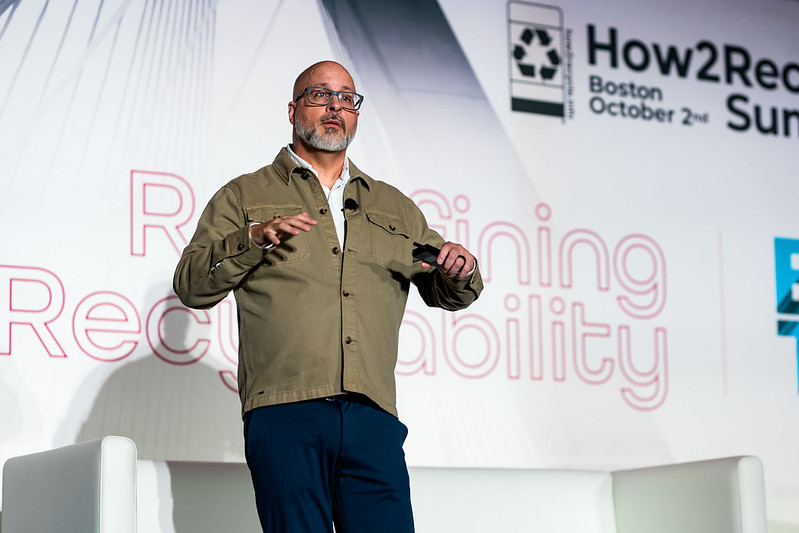
How2Recycle members know that their participation means they’re building something bigger than any one person or company — they’re building a system. And this system that we operate in depends on trust, it’s rooted in transparency, and it needs to be backed by data. At the 2025 How2Recycle Summit, experts from CalRecycle to Circular Action Alliance showed us how each facet of this system is changing.
The message from every expert? Transparency and cross-industry collaboration aren’t just nice-to-haves anymore — they’re requirements for operating in this new packaging paradigm. Dive into key takeaways from the experts raising the bar for recycling and setting new standards for labeling.
Four Takeaways from the 2025 How2Recycle Summit
1. Transparency Builds Trust for Consumers and Companies Alike
The recycling industry is built on trust — trust that companies are giving clear disposal instructions, trust that the materials consumers recycle really get reprocessed, and trust that consumers will make the right, informed disposal decision. If trust is the house the recycling industry is built on, transparency is the foundation that keeps it standing.
This year, at the How2Recycle Summit, we saw incredible strides toward advancing transparency across our industry. With the release of the How2Recycle Decision Matrix, How2Recycle consolidated and made public the data across our five recyclability criteria: collection, sortation, reprocessing, end markets, and applicable law. Whether you’re designing packaging, making procurement choices, or advocating for better recycling systems, this Matrix sheds light on the most common packaging materials’ How2Recycle label eligibility.
Complementing this, How2Recycle’s Nyssa Thongthai and Marina Solis served as guides on the “Highway to Widely Recyclable.” Their message was clear: There is one track to achieve the Widely Recycle label, and every checkpoint — from collection to end markets — must be met.
Plus, key industry innovations were unveiled, like the APR Design Assessment Tool powered by Recyda, which is designed to help packaging producers evaluate recyclability against the latest APR Design Guide standards. Through these tools and frameworks, the industry took one large step forward toward making recycling outcomes more predictable and trustworthy for everyone.
2. Across Companies and Continents: Working Together Moves the Industry Forward
No single company or organization can solve recyclability challenges alone. During the How2Recycle Summit, we saw powerful examples of cross-industry collaboration toward more circular systems. As GreenBlue Executive Director Paul Nowak said in his opening remarks, “We don’t win when we pit ourselves against each other. We win when we get together and enact change.”
Where did we see collaboration success stories? During the How2Recycle Summit, Ecosurety’s James Piper and GreenBlue’s Thomas Pollock highlighted efforts to harmonize recycling and disposal labels in the U.S. and in the U.K. Despite disparate recycling rules — the U.K. benefitting from consistent national laws, the U.S. dealing with a patchwork of state policies — the two label programs share best practices in order to improve consumer education across continents.
In conversations with experts from The Recycling Partnership, the Aerosol Recycling Initiative, the Can Manufacturing Institute, and The Household & Commercial Products Association, we also learned how explicit access data and new methodologies can help shape aerosol recyclability in the years to come. “This is a really great opportunity to lean into partnership across the industry,” The Recycling Partnership’s Ali Blandina said. “We can push this issue forward as an industry and solve it together, not in silo.”
3. Better Data, Better Labels, Better Disposal Decisions
If trust is the house we’re all living in and transparency is the foundation, then good data sets are the bricks keeping it all together. At the How2Recycle Summit, sessions showed us how data on everything from acceptance to end-market evaluations are informing labeling and sustainable packaging decisions.
In her session on end market evaluations, How2Recycle’s Karen Hagerman emphasized that credible recyclability hinges on strong end markets. How2Recycle’s assessment of this recyclability criteria considers four key factors: volume and capacity, demand stability, economic viability, and responsibility. To get even better data on end market demand, the industry can continue work to close gaps across inconsistent data and end market demand varying across regions.
Can better data save the day? In the case of coated cartons, we’re proud of the work that the Carton Council of North America did to develop sufficient data demonstrating high levels of community acceptance for cartons in California. During the How2Recycle Summit, the Carton Council of North America’s Jordan Fengel emphasized the role that collaboration and data sharing played in advancing carton recyclability: “There has been a lot going on this year with cartons,” he said. “Getting the full value chain working together, from consumers to mills, is essential for moving carton recycling forward and turning challenges into real industry wins.”
4. Policy is Already Shaping Practice
From Extended Producer Responsibility (EPR) programs in Canadian provinces to state-level labeling laws like California’s SB 343, at the 2025 How2Recycle Summit, we saw firsthand how policy is transforming packaging and labeling strategies across the industry.
During the How2Recycle Summit, CalRecycle’s Karen Kayfetz sat down with GreenBlue Executive Director Paul Nowak to break down the role her agency plays in advancing circularity across the Golden State. “We want to be sure that science is the basis for all of our decisions,” Kayfetz said. “Everyone on my team is a scientist, and we are making science-based policies.”
Moving from California to Canada, Reverse Logistics Group’s Jade Bässler broke down the process behind Canadian provinces’ move to full producer responsibility. We learned that these provincial programs are increasingly harmonized, with federal overlays on Plastics Registries, draft labeling, and recycled content. While rules vary province-to-province, Bässler shared that companies who continue to make precise, verifiable claims on packaging will be increasingly rewarded.
The Path Ahead: Recyclability Redefined
At the How2Recycle Summit, we heard loud and clear that the path to Widely Recyclable is a journey, and success requires unassailable data, cross-industry collaboration, and policy compliance.
As evolving legislation and consumer expectations raise the stakes, GreenBlue Executive Director reminded us of the values that unite How2Recycle members and stakeholders: “We’re on a mission to get materials to the right place, whether that’s the landfill or the recycler. And it’s our responsibility to instruct the consumer on the next place for the packaging we provide them with,” Nowak said. “As we navigate these changes together, we need to look through the landscape and say: ‘Where’s my place in this puzzle?’”